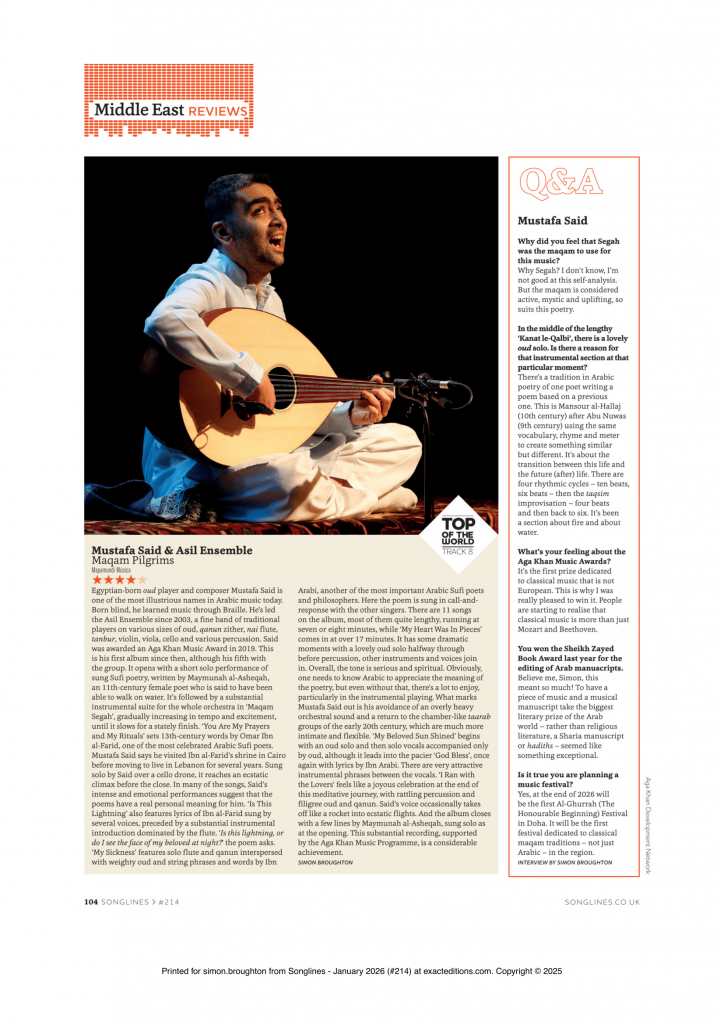
 Q & A
Q & A
Mustafa Said
Why did you feel that Segah was the maqam to use for this music?
Why Segah, I don't know. I'm not good at self-analysis; however, the maqam is considered active, mystic and uplifting, so it suits this poetry.
In the middle of the lengthy 'Kanat le-Qalbi', there is a lovely oud solo. Is there a reason for that instrumental section at that particular moment?
There's a tradition in Arabic poetry of one poet writing a poem based on a previous one. This is Mansour al-Hallaj (10th century) after Abu Nuwas (9th century) using the same vocabulary, rhyme and meter to create something similar but different. It's about the transition between this life and the future (after) life. There are four rhythmic cycles, ten beats, six beats, then the taqsim improvisation, four beats and then back to six. It's been a section about fire and about water.
What's your feeling about the Aga Khan Music Awards?
It's the first prize dedicated to classical music that is not European. This is why I was really pleased to win it. People are starting to realise that classical music is more than just Mozart and Beethoven.
You won the Sheikh Zayed Book Award last year for the editing of Arab manuscripts.
Believe me, Simon, this meant so much! For a piece of music and a musical manuscript to win the biggest literary prize in the Arab world, rather than a religious work, a Sharia manuscript, or hadiths, seemed exceptional.
Is it true you are planning a music festival?
Yes, at the end of 2026, the first Al-Ghurrah (The Honourable Beginning) Festival will take place in Doha. It will be the first festival dedicated to classical maqam traditions - not just Arabic - in the region.
Interview by Simon Broughton.
Songlines Magazine. January 2026 issue.